

Arabic is not unusually expensive to translate, but it is unusually expensive to publish.
Most pricing guides for Arabic open with the same claim: the language is harder, so it costs more per word. When you actually compare published rate cards, that story falls apart.
The cost is real. It just does not live where those articles say it does.
What Arabic actually costs per word
Here is the part that surprises most buyers. On a single agency rate card, using one consistent methodology, Arabic prices roughly in line with major European languages.
| Language pair | Published per-word rate |
|---|---|
| English to Spanish | $0.08 |
| English to Arabic | $0.13 |
| English to French | $0.14 |
| English to German | $0.14 |
| Arabic to English | $0.16 |
Source: GTS translation price per word. Comparing rates across different vendors is unreliable because each one bundles review, project management, and minimum fees differently, so a single card is the only fair comparison.
Specialist providers quote higher. Industry Arabic, an Arabic-only agency, lists $0.16 to $0.23 per word for large ongoing projects. Broader guides put English to Arabic between $0.08 and $0.20 depending on subject matter, with business content at the bottom and legal work at the top.
So the honest range is $0.08 to $0.23 per word, which overlaps almost entirely with French and German. If someone quotes you a large Arabic premium on the base rate alone, ask what it covers.
Where the Arabic premium actually shows up
The extra money appears in the line items underneath the translation.
Right-to-left desktop publishing. This is the biggest documented surcharge. Vendors add roughly 30% to their baseline page rate for right-to-left languages, on top of a typical $1 to $3 per page, according to DTP Labs. The reason is mechanical: layouts, columns, tables, and callouts all have to be mirrored, and that needs an operator who can read the result.
Certification. Certified English to Arabic translation commonly adds 20% to 30% over the base rate, which matters for legal filings, immigration paperwork, and regulatory submissions.
Minimum fees. Short jobs rarely bill by the word. Industry Arabic charges a flat $99 for translation under 500 words, rising to $147 when certified. A 40-word product description therefore costs the same as a 400-word one.
Rush turnaround. A 25% surcharge for expedited delivery is standard.
Stack those together on a legal document that needs certification, layout work, and a fast turnaround, and the effective cost lands far above the headline per-word figure. That gap, not the base rate, is what people are describing when they call Arabic expensive.
The dialect question multiplies your word count
Arabic is not one target. Modern Standard Arabic is the formal written standard understood across the Arab world, and it is the correct default for documentation, legal text, interface strings, and product content.
Regional dialects behave differently. Gulf, Egyptian, Levantine, and Maghrebi Arabic diverge enough that marketing and conversational copy often reads as foreign when written in Modern Standard Arabic.
Be careful with how this gets priced. No vendor publishes a “dialect surcharge” percentage, and specialist agencies quote the same per-word rate whichever variety you pick. The cost multiplication is simpler than a surcharge: each dialect is a separate translation job. Covering three variants means paying for three full passes over the same source text.
For most teams shipping software, catalogs, or help content, one Modern Standard Arabic pass is the right call. Save dialect work for campaign copy where tone genuinely drives conversion.
Right-to-left is an engineering cost, not a translation cost
This is the line item nobody quotes you, because no translator can invoice for it.
Arabic reverses your interface. Text direction flips, navigation mirrors, progress indicators and arrows point the other way, and any layout built on margin-left or text-align: left breaks. The modern fix is CSS logical properties such as margin-inline-start, which let a layout mirror itself, but retrofitting an existing codebase to use them is real work.
DeepL described exactly this when it added Arabic in 2024, its first right-to-left language after roughly thirty left-to-right ones. In the company’s own words, the launch “required us to rethink the way our website and interface worked, from text direction to menu layouts”.
There is a smaller trap in numbers. Some Arabic-speaking markets use Eastern Arabic-Indic numerals (٠١٢٣) while others use the Western digits you already have, so number formatting is not even consistent across the region. Decide which convention each market gets before your data is translated, not after.
No credible published figure exists for what a right-to-left retrofit costs in engineering time. Treat it as a project with its own scope rather than a percentage bolted onto a translation quote.
Machines charge nothing extra for Arabic
Here is the contrast worth internalising. The major machine translation vendors price Arabic identically to every other language:
- Google Cloud Translation: $20 per million characters, with the first 500,000 per month free, and no Arabic-specific tier. (pricing)
- Azure AI Translator: $10 per million characters, flat across supported languages. (pricing)
- DeepL: per-character pricing that does not vary by language pair.
The script complexity, the shaping rules, the dialect landscape: none of it moves the API meter. That tells you something useful. The Arabic premium is a publishing and review premium, not a language-processing premium. It appears the moment output has to be laid out, checked, and imported back into a real system.
This is also why the AI versus human translation tradeoff looks different for Arabic than the sticker prices suggest.
What this means for CSVs and product catalogs
Most guides on this topic assume you are translating a document. If your Arabic content is a spreadsheet export, a product feed, or a set of interface strings, the economics change completely.
Consider a product catalog at roughly 25 words per row, covering a title and a short description.
| Catalog size | Approximate words | Professional translation at $0.13/word | AI Glot credits |
|---|---|---|---|
| 100 rows | 2,500 | ~$325, or a minimum fee | ~6€ |
| 1,000 rows | 25,000 | ~$3,250 | ~63€ |
| 10,000 rows | 250,000 | ~$32,500 | ~463€ |
Rates are shown in their published currencies and not converted, because the gap is wide enough that the exchange rate does not change the decision. AI Glot credit costs use the published pack rates, where one credit equals one word in Standard mode and the price per word falls as volume rises.
That spread is the actual reason teams stop hand-translating catalogs. It is not a quality argument, it is an arithmetic one, and the same hidden costs apply to any spreadsheet workflow.
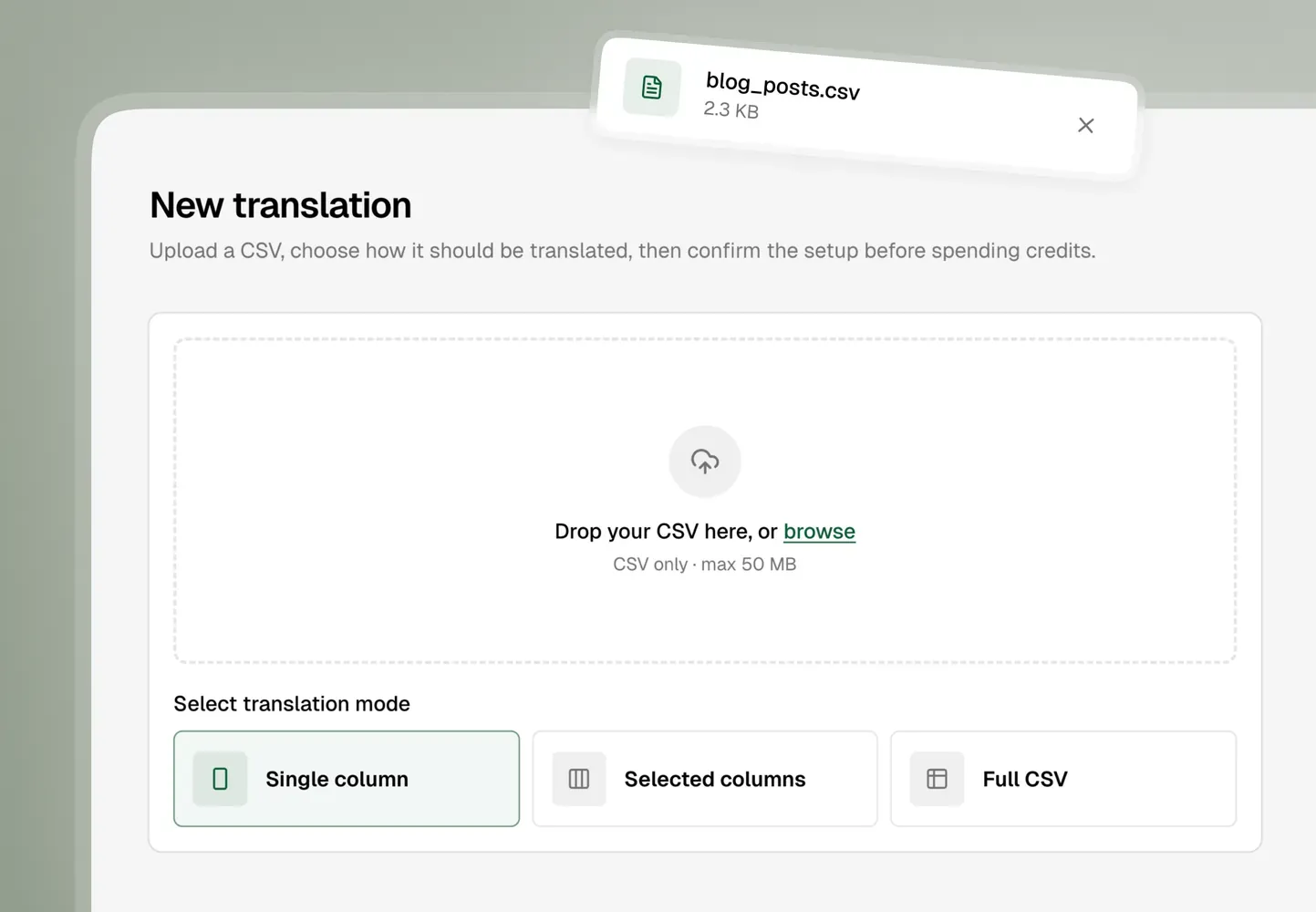
The risk with structured data is different too. A document that translates badly reads badly. A CSV that translates badly fails to import, because a SKU got translated, a delimiter moved, or a column shifted. Arabic makes this worse, since right-to-left text in a spreadsheet cell can look wrong in a preview even when the underlying data is perfectly correct.
How to control the cost
Four decisions do most of the work.
Translate only the columns that carry language. Product titles and descriptions need Arabic. SKUs, handles, record IDs, prices, and image URLs do not, and translating them is how imports break. Selected Columns mode exists for exactly this.
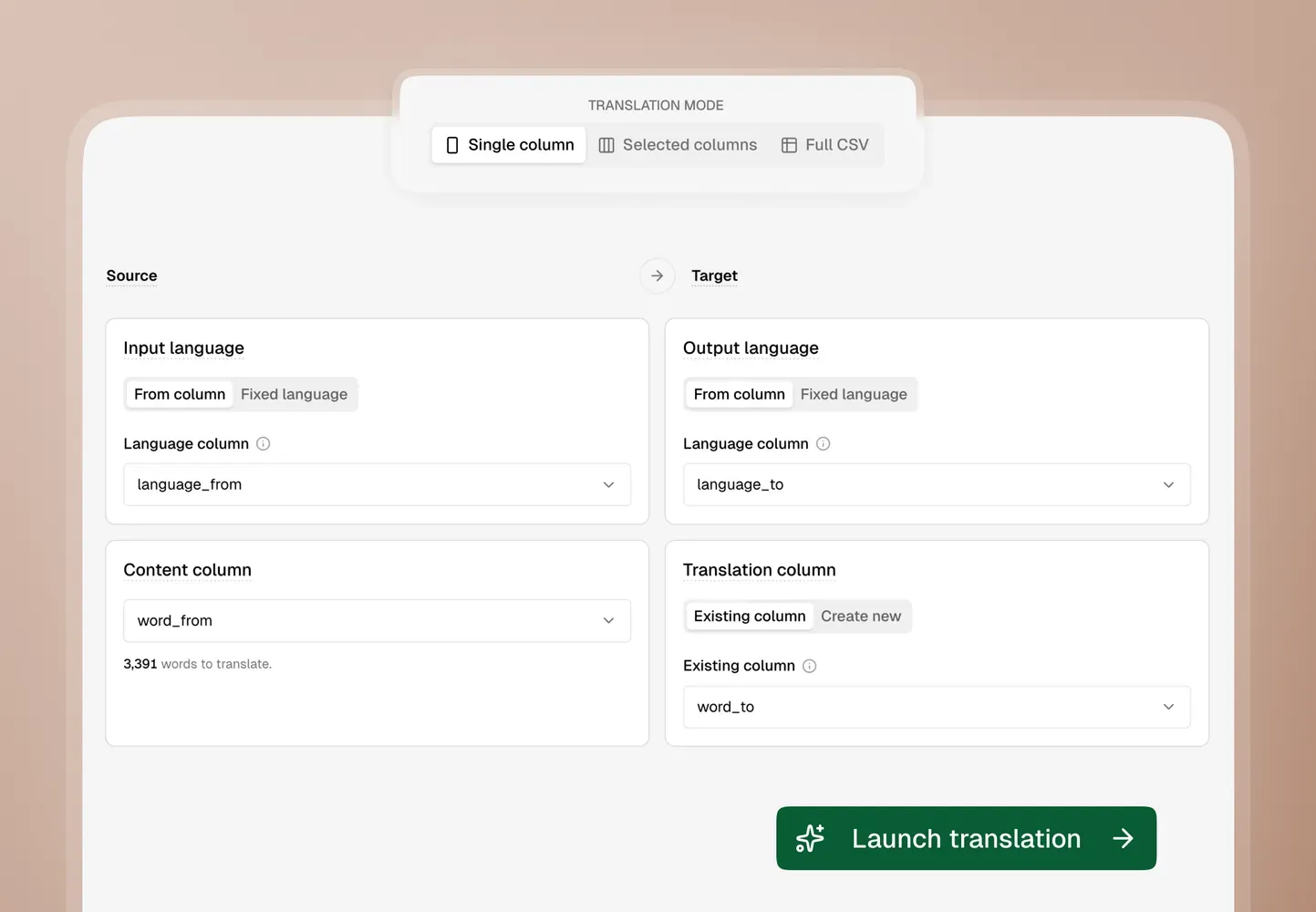
Build a glossary before the first batch. Brand names, product categories, plan names, and technical terms should be fixed in advance. Arabic has genuine variation in how technical vocabulary gets rendered, so a brand glossary prevents the same term appearing three ways across a catalog.
Pick the right processing mode. Standard mode costs one credit per word. Lite mode translates roughly three times more words for the same credits and suits bulk or lower-stakes rows, which is covered in the three translation modes.
Reserve human review for the pages that earn. Your top hundred products, your pricing page, and your legal text deserve a native Arabic reviewer. Your long tail of ten thousand SKUs does not, and paying $0.13 per word for it is how localization budgets die.
The market case for bothering
One statistic makes the argument better than any cost table. Arabic is among the five most spoken languages in the world, yet it accounts for just 0.6% of websites with an identifiable content language, against 6.0% each for Spanish and German, according to W3Techs.
That gap is the opportunity. Arabic-speaking buyers are underserved online relative to their numbers, and with 76% of online shoppers preferring to buy in their native language, the competitive field is noticeably thinner than it is in French or Spanish. The same multilingual SEO principles apply, against far less competition.
The bottom line
Budget Arabic at $0.08 to $0.23 per word for professional human work, which is ordinary. Then budget separately for right-to-left layout, certification where you need it, and the engineering time to make your product display the language correctly, because that is where Arabic genuinely diverges from a French or German rollout.
For catalogs, feeds, and interface strings, the per-word conversation stops being the right one entirely. Structure, glossary control, and a clean import matter more than the rate.
Ready to price your own Arabic project? Try AI Glot and translate a CSV into Arabic with selected columns, glossary rules, and structure-safe output, or see the full credit pricing first.